Nodejs Event-Driven architecture
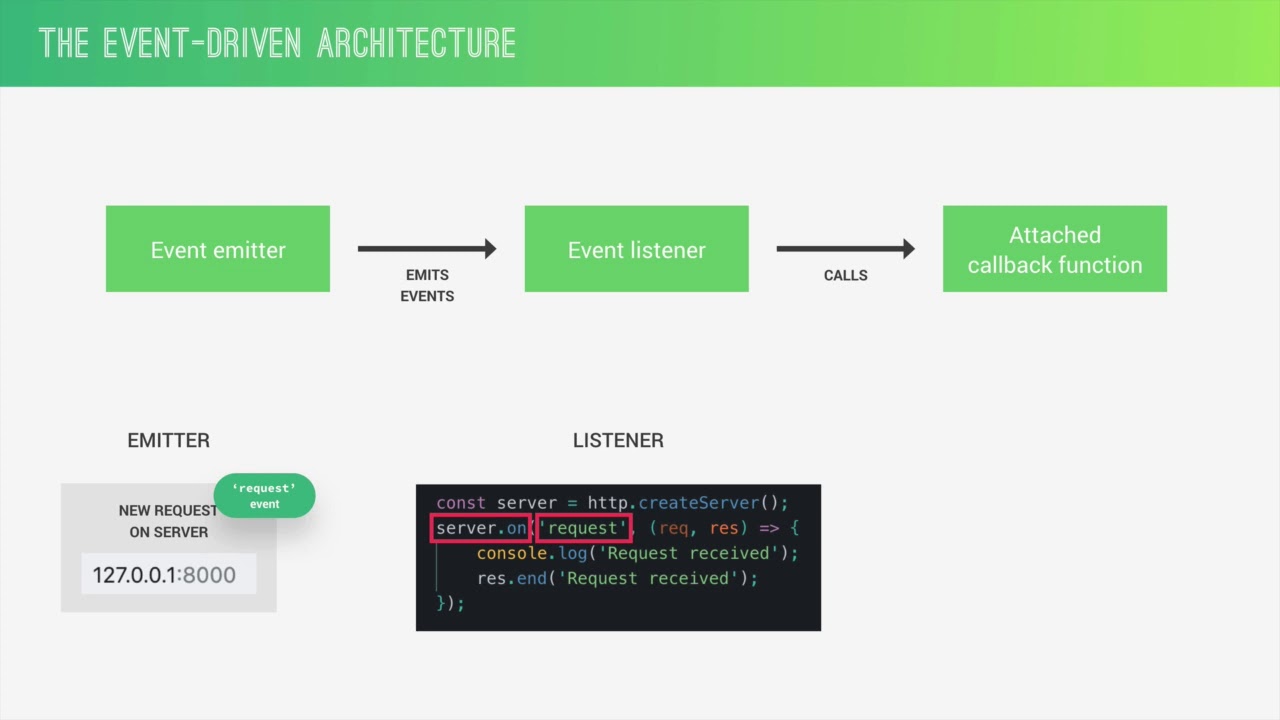
So how the event-driven architecture works?
Dynamic and detail-oriented front-end developer with 3 years of experience in creating visually appealing and user-friendly websites. Proficient in HTML, CSS, and JavaScript, ReactJs, with a strong understanding of responsive design and accessibility standards. Skilled in using frameworks such as Bootstrap, Tailwind.css, and Material-UI to streamline the development process. Strong problem-solving skills and ability to work effectively in a team environment.
Node.js is a JavaScript runtime built on Chrome's V8 JavaScript engine. One of the key features of Node.js is its event-driven architecture, which allows it to handle multiple requests efficiently and concurrently.
In Node.js, an event loop runs in a single thread and handles all the asynchronous I/O operations. When a new request is received, it is added to the event queue, and the event loop picks it up and processes it. Once the request is processed, the event loop moves on to the next item in the queue. This allows Node.js to handle multiple requests at the same time without blocking the execution of other requests.
An example of Node.js event-driven architecture can be seen in a simple HTTP server. The following code creates an HTTP server that listens on port 3000 and responds to a GET request with "Hello, World!":
const http = require('http'); const server = http.createServer((req, res) => { if (req.method === 'GET' && req.url === '/') { res.end('Hello, World!'); } }); server.listen(3000);
In this example, the http.createServer() the method creates a new server and takes a callback function as an argument. This callback function is triggered each time a request is received. Inside the callback function, we check if the request method is GET and the request URL is the root, and if so, we respond with "Hello, World!".
The server.listen() the method tells the server to start listening on port 3000. Once the server is listening, it is ready to handle incoming requests. Each time a request is received, the callback function is added to the event queue and executed by the event loop. This allows Node.js to handle multiple requests concurrently without blocking the execution of other requests.
This is just a simple example of how event-driven architecture works in Node.js. With this architecture, Node.js can handle multiple requests efficiently and concurrently, making it a great choice for building high-performance and scalable applications.